The work
What is inner child work?
Your inner child is the part of you that soaked up emotions, memories and beliefs from your early world, often before you could process what was happening. Kids absorb like a sponge. Language, yes, and also the tone in the room, the tension nobody named, the look on someone's face.
The child's mind may not register it. The nervous system does, and it holds on.
Inner child work is going back to say hello to that younger you. You listen for what they needed, and you learn to give it to them now. And it doesn't have to be all doom and gloom. A lot of it is play: crayons, a song you loved at twelve, your favorite ice cream.
New to this? Meet Your Inner Child is a short, free introduction.
Do I need a big trauma story for this to apply to me?
No. Most of what shapes us is quiet. A need that went unmet a few too many times. A parent who was always a little late. A moment nobody else remembers.
I call these little t traumas, and when they repeat, they can weigh as much as the big ones. Your experience counts, whatever size it came in.
Curious what yours might be? Take the free Little T check-in.
What does "somatic" mean?
Soma means body. So somatic work is any work that includes the body, and I include it because the body is where our emotions get stored.
You can know your whole story. You can understand exactly what happened, where the pattern came from, and why you react the way you do. And your chest still gets tight, or your throat closes right when you need to speak.
That's because the mind isn't the only one keeping the memory. The body holds it too, and the body needs to be addressed. If letting go isn't a felt experience, those emotions stay put and come up in other ways.
The issues are in the tissues.
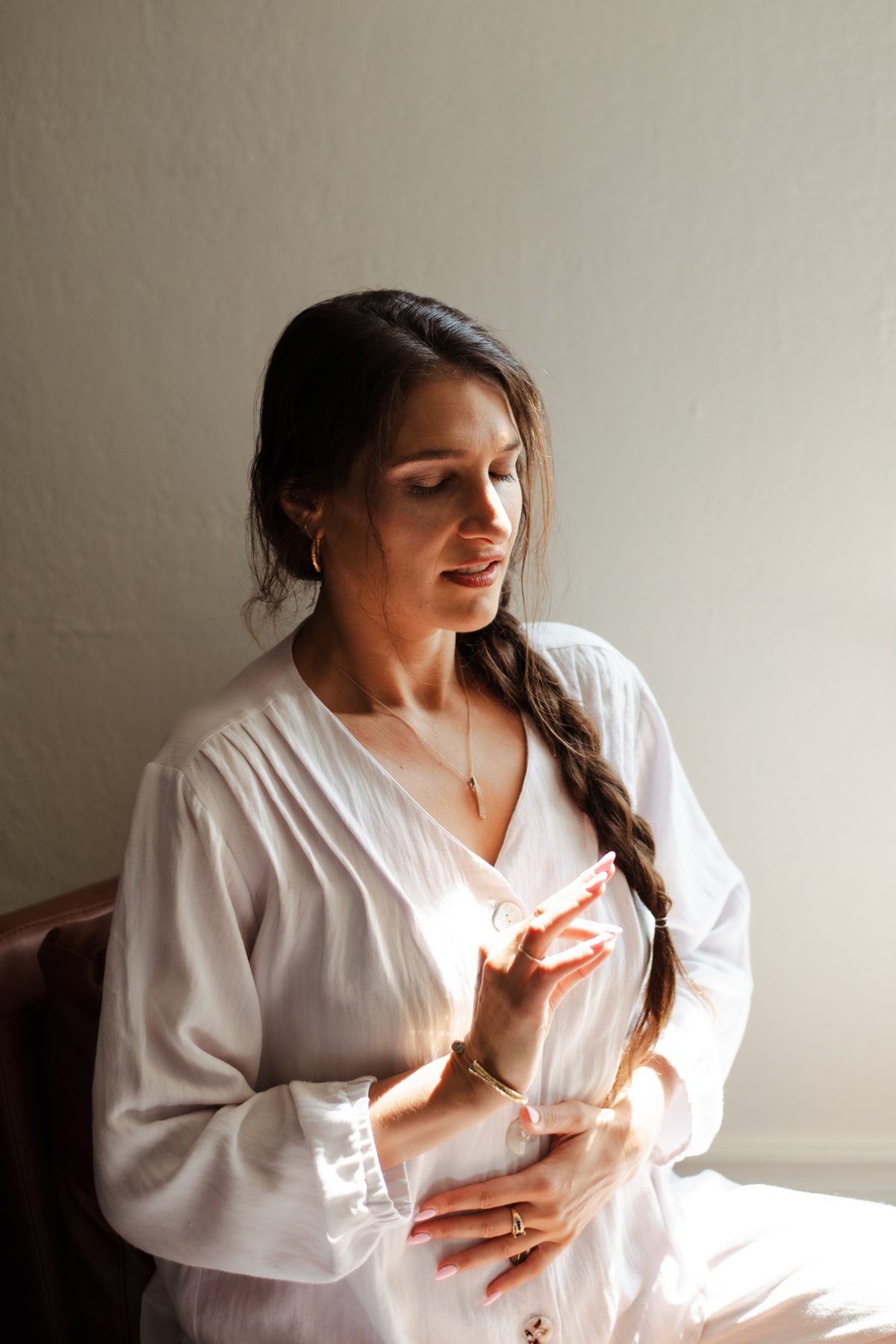
You can't access and heal yourself completely by just going after the mind. You need to get into the body. So in a session we give the body its turn: breath, movement, shaking, tapping, sound, or simply a hand on your heart while you breathe.
You feel what's there, you let it move, you let it pass, and you let it integrate. You don't have to make sense of it first. When I feel, I heal.
So is this therapy, or coaching?
A little of both, and not quite either. I call it somatic healing.
It's therapeutic, and my master's in clinical psychology shapes how I listen and how I hold a session. It isn't psychotherapy, and I don't diagnose or treat mental health conditions.
There's some coaching in it too. Sometimes we make a plan together, or name an emotional goal and work toward it.
What makes it its own thing is the body. We work with what your body is holding, so it can finally move. And it sits really well alongside therapy, if you have a therapist you love.
What is your role, and what is mine?
I am your guide and you are your own great healer, holding the keys to your transformation.
I can show you different pathways and hand you keys all day. You're the one who puts the key in the ignition.
Sessions
What happens in a 1:1 session?
Ninety minutes, built around you in the moment. There's no script.
We usually open with a grounding meditation, then talk through what's actually going on. From there it's somatic unwinding and energy healing, and whatever else the session asks for. Somatic unwinding is simply letting the body release what it's been holding, through breath, movement or stillness. I bring intuitive guidance too, so I tune into what you need as well as what you say.
You leave feeling a softening in your body, and a little more room to be yourself.
A Return to Yourself Session is 90 minutes, $250. Book a session
If your first session didn't feel right for you, let me know within a week and I'll refund half. Three sessions together is $650.
Do you work online or in person?
Mostly online, with people all over the world. In-person sessions are by special request, in the San Diego area.
Online works really well for this. You're in your own space, which makes it easier to settle, and you can go straight into rest afterward. No driving home with your heart wide open.
What if I cry?
Then you cry, and I stay right there with you.
So much of this work is being held and seen with compassion, without anyone trying to fix you. Having your story heard and witnessed is the first step to letting it go. And you set the pace, always.
Do I need experience with yoga or meditation?
Not at all. You don't need to be flexible, or calm, or good at sitting still (who is, at first?). However you arrive is perfect.
How many sessions will I need?
One session stands on its own. Some people come once for a stuck place they can name but can't think their way out of. Some come back when life asks for it.
If you want steady support, the Return to Yourself Immersion is eight weeks, one on one, with me in your back pocket between sessions.
The work itself is never fully done. We're always on the path. The signs I look for along the way: you feel more inspired, more like yourself, there's a lot more self-love, and you have more courage and tools to feel your feelings.
The practices
What is energy healing?
You already know what energy feels like. It's the heaviness you carry around after a hard conversation, or the way a room feels before anyone has said a word.
Energy healing works with that layer of you. You get comfortable and rest while music plays, and I tune into your energy and work with it.
I work with different healing energies, and each has its own frequency and intention. Which one I reach for depends on what you need that day.
Sometimes that's soothing. This kind balances and heals the heart, and it supports emotional balance and nervous system regulation. It's very good when there's excess fear, stress, worry or grief. It feels like being gently held and recalibrated.
Sometimes it's more activating and dynamic. This kind awakens, mobilizes and energizes the system. It can feel like a powerful internal ignition, with more of you coming alive.
How does energy healing work online?
The same way it works in person, minus the hands-on touch.
The way I understand it, there is one field of energy and all of us are part of it. Time and space don't divide it up the way they divide up our days.
So when I tune into the field, I can work with your energy wherever you are. You lie down at home and get comfortable, and I work from my side of the screen.
I know it can sound a little woo-woo. The best test is your own experience, so notice what you feel.
What is intuitive guidance?
It means I'm listening to more than your words.
While you talk, I'm also tuned into your body and into what isn't being said. Maybe your hand keeps going to your throat. Maybe an image or a question comes through for me. When it does, I offer it to you, and you tell me if it lands.
You're the one who knows. I'm just reflecting back what I pick up.
Yoga nidra vs. meditation: what's the difference?
They're cousins. Both bring you inward. What you do once you get there is different.
Meditation
You're usually sitting up, awake, practicing your attention. You rest it on the breath, the heart, an intention. The mind wanders off, you notice, you come back. That coming back is the practice.Yoga nidra
Yogic sleep. I call it the magic nap. You lie down, get as comfortable as you can, and I guide you the whole way. Awareness moves through the body piece by piece until the body rests deeply and you hover between awake and asleep.In that in-between place your brain slows into theta waves, the state you drift through right before sleep. That's where subconscious reprogramming can happen. So the intention you drop into your heart at the start, like a little seed, gets planted deep.
And there is nothing for you to do but relax, rest and receive. You might lose my voice from time to time, and that's okay.
If sitting still with your own mind sounds like a lot right now, yoga nidra is a soft place to start.
Want to hear my voice first? Try a free four-minute meditation.
Getting started
What's your background?
I have an MA in Clinical Psychology and I'm an E-RYT 500. I spent more than ten years with children and families, and five years teaching and training yoga teachers in Bali.
I know how patterns form, and I know the mind alone doesn't reach them.
I'm not ready for 1:1. Where do I start?
Start small, and start free. Take a quiz, listen to the meditation, or read Meet Your Inner Child.
When you want something to work through on your own time, the self-guided resources are there for that.